

Here’s a question I put to every CEO and board I work with: Do you really know where your IT budget is going — and whether it’s delivering value?
It sounds straightforward. But in my experience across franchise businesses of all sizes, the honest answer is usually somewhere between “not really” and “we know what we spend, but we’re not sure what we’re getting for it.”
That gap — between spending and understanding — is where businesses lose ground. Not because they’re spending too much, but because they can’t see clearly enough to spend well.
The Problem With Treating IT as a Cost Centre
In too many franchise organisations, technology sits firmly in the “cost centre” column. The board sees a line item, winces at the number, and asks the IT team to trim it. Year after year, the conversation is the same: “Can we do this cheaper?”
But cheaper isn’t always better. And cost reduction without context is just guesswork.
When you treat IT purely as a cost to be managed, you miss its potential as a lever for growth. Worse, you create a culture where technology leaders are rewarded for cutting spend rather than creating value. That’s a losing strategy in a world where digital capability increasingly determines competitive advantage.
A Simple Framework: Run, Grow, Innovate
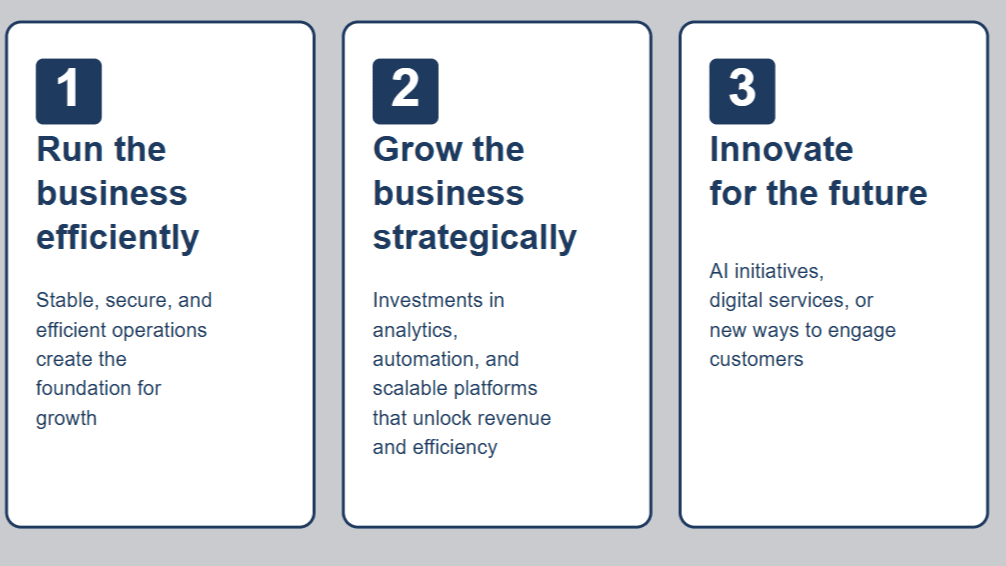
I use a straightforward framework to help franchise businesses get clarity on their IT spend. It’s not new — variations of it have been around for years — but its power lies in its simplicity. Every pound you spend on technology falls into one of three categories:
1. Run the Business Efficiently
This is your foundation. The systems and infrastructure that keep the lights on: your network, your point-of-sale systems, your email, your core franchise management platform.
The goal here is operational gearing. You want systems that scale — where the cost per user or per location decreases as you grow. A franchise with 50 units shouldn’t be paying twice what a 25-unit network pays for the same capability.
Stability, security, and efficiency are the watchwords. This isn’t glamorous work, but get it wrong and nothing else matters. A franchise network that can’t reliably process transactions, communicate with its franchisees, or protect customer data has far bigger problems than its innovation pipeline.
For franchise businesses, ask: Does our cost per site decrease as we add new franchisees? Are we running stable, secure operations that franchisees trust? Could we onboard ten new locations tomorrow without a technology headache?
2. Grow the Business Strategically
This is where IT spend starts to directly enable business outcomes. Think analytics dashboards that give franchisees real-time visibility of performance. Automation that removes manual processes from the support office. Scalable platforms that let you enter new markets or launch new services without rebuilding from scratch.
The key discipline here is linkage. Every investment in this category should connect to a measurable business result. Not “we implemented a new CRM” but “we implemented a CRM that increased franchisee lead conversion by 15%.”
This is also where franchise businesses have a natural advantage. When you have a network of operators all running the same model, the impact of a smart technology investment is multiplied across every location. A tool that saves each franchisee two hours a week isn’t just a productivity gain — across a 200-unit network, that’s 400 hours a week returned to the business.
For franchise businesses, ask: Can we draw a clear line from this investment to revenue growth, cost reduction, or franchisee satisfaction? Are we measuring the outcomes, not just the outputs? Is this investment designed to scale across the network?
3. Innovate for the Future
This is the highest-risk category, but it’s also where disproportionate value lives. AI initiatives that could transform customer engagement. Digital services that open entirely new revenue streams. Predictive analytics that move you from reactive to proactive decision-making.
Not every innovation bet will pay off, and that’s fine. The point is to experiment with purpose — with a clear line of sight to strategic impact, even if the path isn’t fully mapped.
What matters is that you’re making these bets deliberately, with eyes open, rather than either ignoring innovation entirely or chasing every shiny new tool that appears on your LinkedIn feed.
For franchise businesses, ask: Are we allocating a deliberate portion of our budget to experimentation? Do our innovation initiatives have a clear connection to our franchise growth strategy? Are we learning fast from what doesn’t work, and scaling what does?
Why This Framework Matters for Franchise Boards
The real power of this framework isn’t in the categories themselves — it’s in the visibility they create.
When you can show a board that 70% of IT spend is on running the business, 20% on strategic growth, and 10% on innovation, you’ve changed the conversation entirely. You’ve moved from “IT costs too much” to “are we investing in the right balance for our growth ambitions?”
That’s a fundamentally different — and far more productive — discussion.
It also gives franchise leaders the language to have better conversations with franchisees. When you can explain that a technology fee increase is funding a new analytics platform (Grow) rather than just keeping the email servers running (Run), you build trust and buy-in across the network.
Getting Started
If you don’t currently have this visibility, start simple. Take your IT budget and categorise every line item into Run, Grow, or Innovate. Don’t overthink the edge cases — directional accuracy is more valuable than false precision.
Then ask yourself three questions:
- Is our Run spend efficient? Are we getting operational gearing, or are costs growing linearly with the network?
- Is our Grow spend connected to outcomes? Can we demonstrate the business value of our strategic investments?
- Is our Innovate spend intentional? Are we making deliberate bets on the future, or are we either ignoring it or spraying investment without focus?
The answers won’t always be comfortable. But they’ll give you something far more valuable than comfort: clarity.
And clarity is where good technology decisions begin.
Colin Rees is the founder of Xpera, a franchise technology and marketing consultancy. He works with franchise businesses to align technology strategy with commercial outcomes. Get in touch to discuss how your franchise can get more value from its IT investment.